Best Pool Table for a Basement or Game Room
How to fit a pool table in a basement: room size by cue length, lighting, slate weight, stairs, humidity and leveling, plus the tables that suit.
At a glance
For a dedicated basement with a dry floor and a long-term plan, the Playcraft Wheaton 8 ft Slate is the pick, with a real slate bed. The Barrington Arlington 8 ft is the lighter, easier-to-place alternative. On a tighter budget, the Hathaway Hustler 7 ft fits a smaller room and adds a ball return.

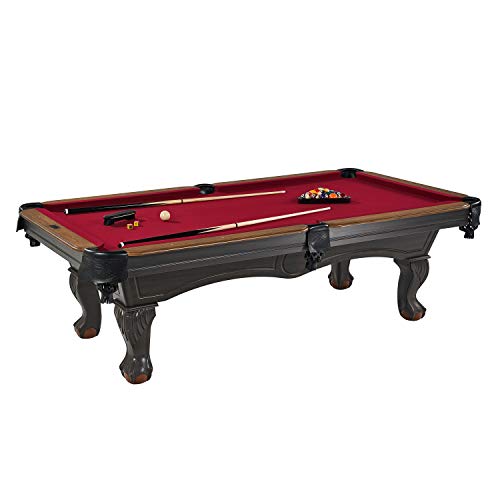
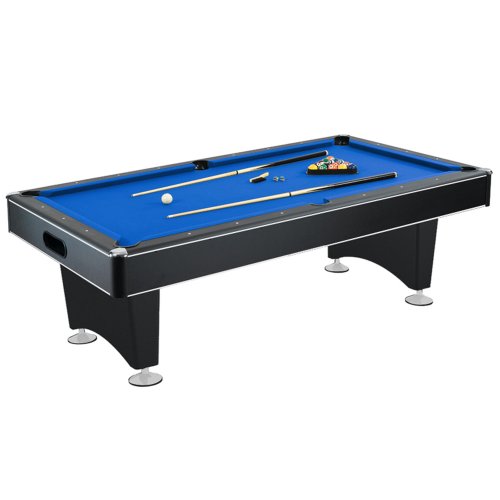
A basement is a popular place for a home pool table, and a common setting for buying mistakes. The floor plan looks roomy on paper until you count the stairs, the support post, the water heater and the 58-inch cue that needs somewhere to swing. Then there is the delivery path, the low ceiling, the light fixture and the question of damp air. This guide walks through each in the order you will run into them, then matches the tables on this site to the kind of basement you have.
We do not handle the tables we cover. We compare the specs and maker information that Playcraft, Barrington, Blue Wave Products (Hathaway’s parent company) and Brunswick Billiards publish, and we say which source each figure comes from. For the full ranking of all nine tables, see our best pool tables of 2026.
Start With the Room, Not the Table
The rule behind every room-size chart is simple: take the playing surface, then add a cue length on every side. With a standard 58-inch cue, that is about 10 extra feet on each dimension, since you need a cue length at both ends and both sides. Brunswick Billiards publishes a chart built on that math. For the two sizes most basements can take, it lists these minimums:
| Table (playing area) | Cue used | Minimum room (width x length) |
|---|---|---|
| 7 ft (38 x 76 in) | 58 in standard | 13 ft x 16 ft |
| 7 ft (38 x 76 in) | 52 in | 12 ft x 15 ft |
| 7 ft (38 x 76 in) | 48 in | 11 ft 6 in x 14 ft 6 in |
| 8 ft (44 x 88 in) | 58 in standard | 13 ft x 17 ft |
| 8 ft (44 x 88 in) | 52 in | 12 ft x 15 ft 6 in |
| 8 ft (44 x 88 in) | 48 in | 11 ft 2 in x 15 ft |
Two cautions on those numbers. First, Brunswick’s own summary text for the 8 ft table says 13 ft 6 in x 17 ft, six inches wider than its chart row, so if your room is close to the line, plan for the larger figure. Second, Barrington Billiards states its own recommendation for the Arlington 8 ft: a 17 ft x 13.5 ft space, which it says leaves about 5 ft of clearance around the playing surface. Brunswick’s FAQ gives the same 5 ft figure as the comfortable standard.
What counts is the open floor. Measure wall to wall, then subtract everything that cannot move: a support column, a stair stringer, a furnace closet, a floor drain you want to keep reachable, a wet bar. A 14 ft x 20 ft basement with a column in the middle of the long wall may have less usable table space than a clean 13 ft x 18 ft room.
When the Room Is a Little Short
Shorter cues are the usual fix, and the chart shows how much they buy you. Moving from a 58-inch to a 48-inch cue saves about 2 feet on each dimension for an 8 ft table, according to Brunswick’s numbers. The cost is a cramped stroke when you shoot along a wall, so it works best when only one wall is tight. Brunswick also lists rearranging furniture, a smaller table and wall-mounted cue storage as options. If two walls are tight, step down to a 7 ft table instead of fighting every shot.
Ceiling Height and Lighting
A basement ceiling is usually lower than the ceiling upstairs, and the table needs a light over it. Blatt Billiards recommends hanging the fixture so its bottom sits 31 to 33 inches above the playing surface, and says to avoid going above 36 inches, where the light loses intensity, or below 30 inches, where the shades can block the view of the table. It also says to measure from the felt, not the floor.
Here is what that means on a low ceiling. Barrington and GLD both list their tables at about 31 inches tall overall, and the felt sits slightly below the top of the rails. If the felt is about 30 inches off the floor, a fixture hung 31 to 33 inches above it ends up roughly 5 ft 1 in to 5 ft 3 in off the floor. That is our arithmetic, not a maker figure, but it suggests that even a 7 ft ceiling leaves room for a low-profile fixture. The practical limit on a low ceiling is the length of the chain or rod, so Blatt advises a low-profile fixture when the ceiling is low and an adjustable chain or rod when it is high.
Fixture size matters too. Blatt says three-shade fixtures typically suit 7 ft and 8 ft tables. Before you buy any light, check for ductwork, beams and pipes along the line where the light will hang.
Weight, Stairs and Delivery
This is the part that decides whether slate is realistic for you. Playcraft lists the Copenhagen 8 ft Slate at about 800 lbs assembled. The Amazon listing for the Wheaton 8 ft Slate gives about 850 lbs. Playcraft’s Wheaton page lists a slate shipping box at 545 lbs, and the Copenhagen page lists a slate pallet at 605 lbs, so a delivery crew is handling heavy individual pieces, not small boxes.
The non-slate tables are much lighter. Barrington lists the Arlington 8 ft at 251.9 lbs. GoSports says its 8 ft table weighs over 200 lbs, and the Amazon listing says about 272 lbs. Blue Wave Products does not publish a weight for the Hustler 7 ft on the page we opened.
Practical steps before ordering any table:
- Measure the route. Door width, stair width, landing size, turns, and the lowest point of the ceiling along the path, including soffits and ductwork.
- Check the longest box. Playcraft’s Copenhagen page lists a cabinet box 97 inches long, which has to turn a stairwell corner. Ask the seller for box dimensions for any table you shortlist.
- Know who carries it. GoSports states on its page that free shipping is inside the front door only, so the box is yours to move from there. Playcraft says professional installation is required for the Wheaton and recommended for the Copenhagen.
- Plan the floor. On a concrete slab, 800 lbs spread over a table footprint of roughly 41 sq ft (our arithmetic from the Copenhagen’s listed 102 1/4 x 58 1/4 inch size) is about 19 lbs per square foot, and the legs concentrate it. A slab can generally handle that. If the room sits over a framed floor, ask a builder or structural engineer, because we cannot give a safe-load figure for your house.
Humidity, Concrete and Leveling
Wood-based beds respond to moisture. Pool Table Portfolio explains that wood exchanges moisture with the air and changes dimensions as its moisture content changes, and that a finish slows this but does not stop it. It cites U.S. EPA guidance to keep indoor humidity below 60 percent, ideally 30 to 50 percent where possible, and adds that this is general mold-prevention advice rather than a guarantee for pool tables. Its practical advice is to ask the table’s maker for its humidity range.
Pool Table Portfolio says a basement is not automatically damp and recommends measuring conditions and finding the real moisture sources before buying a dehumidifier. A hygrometer costs little and tells you more than guesswork. If the number runs high, a dehumidifier can help, but it does not stop water from entering through a leak or a building defect, so fix those first.
Concrete adds its own complication. A retailer guide from Home Billiards says concrete floors are prone to sweating in warm weather, and that a small rug or carpet under the table can insulate it and add stability. That guide was written about garages, but the point applies to a slab-floor basement as well. Whether you have carpet, vinyl plank or bare slab, plan to level the table after it settles. Set a long bubble level on the playing surface, adjust the levelers in both directions, then check again after a few weeks, because carpet and pad compress under the legs.
Slate or Not Slate for a Basement
Only the two Playcraft tables on this site are real slate. Playcraft describes the Wheaton’s bed as 1-inch book-matched slate honed to 1/1000th of an inch, and the Copenhagen’s as a 3-piece system of 1-inch backed slate. The Fat Cat Frisco’s Accuslate is described by GLD as a lightweight alternative to slate, so we do not call it slate. The Hathaway Augusta uses a 1-inch MDF surface and the Hustler a 3/4-inch MDF surface, per Blue Wave. Barrington lists the Arlington’s surface as 25 mm engineered wood.
The long-term trade-off is straightforward. Slate generally costs more to buy, deliver and install, and it stays flat in a stable room. MDF and engineered wood are lighter and easier to deliver, and they ask more of the room: dry air, a good level and no heavy items parked on the bed. If the basement is dry and the table is for family games, a non-slate table is a reasonable choice. If the table is the centerpiece and you want to keep it for decades, slate is the better long-term purchase.
Tables That Fit a Basement
Playcraft Wheaton 8 ft Slate: For a Dedicated Game Room
The real-slate pick for a finished basement that is a dedicated game room. Playcraft lists a three-piece slate bed, a 44 x 88 in playing surface and a 5-year warranty, with professional installation required.
Best for a dry room of at least 13 ft x 17 ft where you want a table that stays flat for years. Plan on a delivery crew, an installer, and a route that can handle very heavy pieces. Details are in our Playcraft Wheaton profile. If you prefer a modern look, the Playcraft Copenhagen 8 ft Slate has the same 44 x 88 in playing area in a solid hardwood cabinet and an optional dining top, at about 800 lbs.
Barrington Arlington 8 ft: Lighter and Easier to Place
A non-slate 8 ft table for basements where a slate delivery is not practical. Barrington lists a preassembled playfield, steel legs, accessories in the box and a recommended 17 x 13.5 ft room.
At 251.9 lbs by Barrington’s spec, it is far easier on stairs and floors. Know the trade-off: the playfield is listed at 84 x 42 in, shorter than the 88 x 44 in standard, and the surface is engineered wood, so keep the room dry and the level true. See the Barrington Arlington 8 ft profile.
Hathaway Hustler 7 ft: A Smaller Room and a Tighter Budget
An entry-level 7 ft cabinet table with a 3/4 in MDF bed and an integrated ball return. A fit for a basement that cannot take an 8-footer.
A 7 ft table fits Brunswick’s 13 ft x 16 ft minimum, or 11 ft 6 in x 14 ft 6 in with a 48-inch cue. The ball return keeps games moving when guests are playing. Blue Wave sells the Hustler in 7 ft and 8 ft versions on one page, so confirm the listing is the 7 ft. Details are in the Hathaway Hustler 7 ft profile.
Quick Matching by Basement Type
- Dry, finished, long-term game room, 13 x 17 ft or larger: Wheaton, or Copenhagen for a modern room.
- Finished basement with a hard delivery path or a framed floor: Arlington, because it is much lighter.
- Smaller or multi-use space: Hustler 7 ft, or the dining-top Newport described in our Hathaway Newport profile.
- Damp or unfinished basement: fix the moisture first. No table here is a good match for standing water.
Before You Order
- Measure the open floor and compare it with Brunswick’s chart for your cue length.
- Walk the delivery path with a tape measure, including the lowest ceiling point.
- Put a hygrometer in the room for a few weeks.
- Decide on a light fixture that fits your ceiling.
- Confirm the listing size, since several makers sell more than one size under one name.
Buying through our links may earn a commission at no cost to you.
Sources
- Pool Table Room Size Guide, Brunswick Billiards
- How High Should a Pool Table Light Be, Blatt Billiards
- Humidity and Wood: Why Your Table Needs a Stable Environment, Pool Table Portfolio
- Pool Table in a Garage, Home Billiards
- Playcraft Wheaton 8 ft Slate official product page
- Playcraft Copenhagen 8 ft Slate official product page
- Barrington Billiards Arlington 8 ft official product page
- Hathaway Hustler Pool Table with Ball Return, Blue Wave Products official product page
- Hathaway Augusta 8 ft official product page, Blue Wave Products
- Fat Cat by GLD Products Frisco 7.5 ft official product page
- GoSports 8 ft Pool Table with Wood Finish, official product page
Frequently asked questions
How big a room do I need for an 8 ft pool table in a basement?
Brunswick Billiards' chart lists a minimum of 13 ft x 17 ft for an 8 ft table (44 x 88 in playing area) with a standard 58-inch cue. With a 52-inch cue it drops to 12 ft x 15 ft 6 in, and with a 48-inch cue to 11 ft 2 in x 15 ft. Barrington recommends 17 ft x 13.5 ft for its Arlington 8 ft. Measure the open floor, not the room, because stairs, support posts and a furnace closet cut into it.
How high should the light hang over a pool table in a basement?
Blatt Billiards recommends about 31 to 33 inches from the bottom of the fixture to the playing surface, and says to avoid going above 36 inches or below 30 inches. Measure from the felt, not the floor. For a low basement ceiling, pick a low-profile fixture rather than a long hanging one.
How much does a slate pool table weigh, and can a basement floor handle it?
Playcraft lists the Copenhagen 8 ft Slate at about 800 lbs, and the Amazon listing for the Wheaton gives about 850 lbs. On a concrete slab, weight is usually less of a concern. On a framed floor above a crawl space or in an upper-level game room, ask a builder or structural engineer before you buy, because we cannot give a safe-load figure for your house.
Do I need a dehumidifier for a basement pool table?
Only if your basement is actually damp. Pool Table Portfolio cites EPA guidance to keep indoor humidity below 60 percent, ideally 30 to 50 percent, and notes that no single humidity range is verified for every table, so ask the maker for its range. Put an inexpensive hygrometer in the room for a few weeks first. A dehumidifier helps with excess moisture but does not fix a leak.
Is slate worth it for a basement?
If you plan to keep the table for many years and play often, a slate bed is the better long-term buy, because MDF and other wood-based beds respond to moisture. If the table is for casual family play, a lighter non-slate table such as the Barrington Arlington 8 ft is easier to deliver and set up, as long as the room stays dry and you check the level.
Can I put a pool table on carpet?
Yes, but carpet and pad compress under the legs over time. Level the table once it is assembled, then check again after a few weeks and adjust the levelers. A table with built-in levelers makes this easy.